
The world’s most expensive spice, often called “Red Gold,” is a staple in royal kitchens and luxury wellness routines. But with a price tag that rivals precious metals, saffron is also one of the most counterfeited food products on earth.
Whether you are making a fragrant Biryani, a healing cup of Kesar milk, or using it for skincare, using fake saffron isn’t just a waste of money—it can be a health hazard.
This guide will turn you into a saffron pro. We will decode Real vs fake saffron, explore the legendary Original Kashmiri Saffron, and teach you how to check pure saffron at home.
The “Red Gold” Rush: Real vs Fake Saffron
Saffron comes from the stigma of the Crocus sativus flower. It takes roughly 75,000 flowers to produce just one pound of spice, which explains the high cost. Unfortunately, this value invites fraudsters.
Fake saffron is often made from dyed corn silk, safflower petals, coconut filaments, or even dyed paper strips. Worse, it may be weighed down with oil, glycerin, or red dyes that can be harmful.
Why It Matters:
- Health Risks: Artificial dyes (like tartrazine) and fillers used in fake saffron can cause allergic reactions or digestive issues.
- Culinary Disappointment: Fake saffron lacks the chemical compound Safranal (aroma) and Crocin (color), meaning your dish will look dull and taste metallic instead of floral.
- Financial Loss: You are paying premium prices for colored hay.
How to Check Pure Saffron at Home: 3 Foolproof Tests
You don’t need a lab coat to perform a Saffron purity test. Here are three simple experiments you can do in your kitchen.
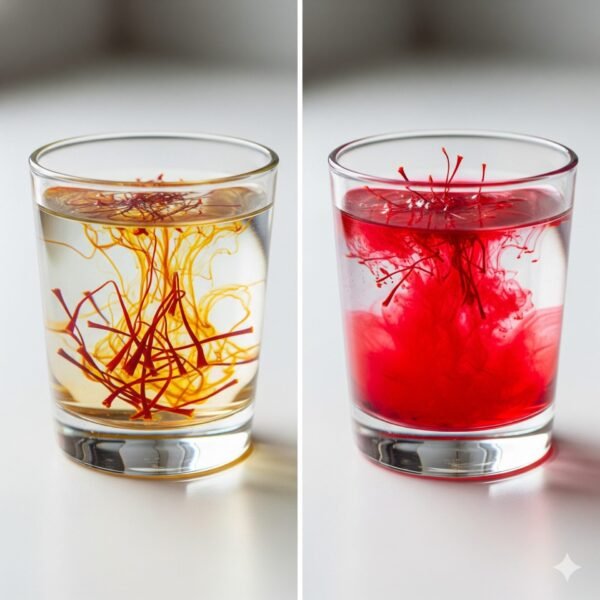
Test 1: The Cold Water Test (The Golden Standard)
This is the most effective method to see the “bleeding” of color.
- Take a glass of cold water.
- Drop 2-3 strands of saffron into it.
- Real Saffron: It will slowly release a golden-yellow hue. It takes about 10-15 minutes for the water to turn vibrant yellow. Most importantly, the threads remain red.
- Fake Saffron: It releases a dark red or orange color immediately (like food coloring). After a few minutes, the threads will lose their color and turn white or colorless.
Test 2: The Baking Soda Test
Science is on your side here.
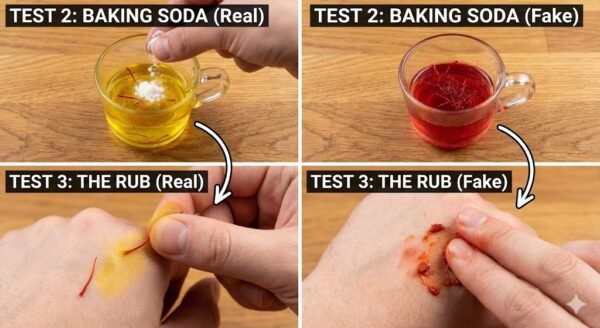
- Mix a pinch of baking soda in a small cup of water.
- Add a few saffron threads.
- Real Saffron: The mixture will turn yellow.
- Fake Saffron: The mixture will likely turn dim red or remain colorless.
Test 3: The Rub Test
After soaking the threads in cold water, take one out and rub it between your fingers.
- Real: The thread will feel intact and won’t break apart easily. It will leave a yellow stain on your fingers.
Fake: The thread will disintegrate into dust or a mushy paste.
The Sensory Check: Sight, Smell, and Taste
Before you even open your wallet to buy Premium Kashmiri saffron online, knowing what to look for is crucial.
- The Look (Sight)
- Real: Authentic saffron threads are trumpet-shaped. They are thick at one end and taper to a thin point. The color is a deep, vivid crimson. You might see a tiny yellow tail at the base (the style), which is natural.
- Fake: Fake strands often look like straight wires or shredded paper with no trumpet shape. If the threads are completely uniform in redness without any variation, be suspicious.
- The Aroma (Smell)
- Real: Real vs fake saffron is easily distinguished by the nose. Real saffron has a distinct, potent scent—a mix of honey, hay, and a slightly metallic or medicinal edge.
- Fake: Fakes often smell like nothing (just dry hay) or have an overly sweet, candy-like chemical scent (vanilla or sandalwood essence) added to mask the lack of natural aroma.
- The Palate (Taste)
- Real: Never buy sweet saffron! Real saffron is actually bitter in taste.
- Fake: If you put a strand on your tongue and it tastes sweet, it has been dipped in honey or glycerin to add weight.
The Crown Jewel: Original Kashmiri Saffron
When discussing quality, Original Kashmiri Saffron (Mongra) sits at the very top. Grown in the Pampore region of Kashmir, it is the only saffron in the world grown at an altitude of 1,600m to 1,800m.
What makes it unique?
- Darkest Color: Kashmiri saffron is famous for its dark maroon-purple hue, indicating the highest levels of Crocin (coloring strength).
- Thicker Strands: The stigmas are longer and thicker than Iranian or Spanish varieties.
- Potency: You need half the quantity of Kashmiri saffron to get the same result as other types.
If you want the full therapeutic experience, always look for GI-tagged (Geographical Indication) Kashmiri saffron to ensure you aren’t buying a blend.
Unlock the Golden Health: Kesar Benefits
Beyond the flavor, the Kesar benefits for health are scientifically backed.
- Potent Antioxidant: Rich in compounds like crocin and kaempferol, it helps fight oxidative stress and protects brain cells.
- Mood Booster: Saffron is nicknamed the “sunshine spice” not just for its color but for its ability to treat mild-to-moderate depression and anxiety.
- PMS Relief: Studies show that smelling or consuming saffron can reduce symptoms of PMS, including irritability and pain.
- Vision Health: It improves eyesight in adults with age-related macular degeneration (AMD).
- Heart Health: Its anti-inflammatory properties lower cholesterol levels and prevent blood vessels from clogging.
The Perfect Pair: Saffron and Cardamom Whole
In the world of spices, some marriages are made in heaven. Saffron provides the color and floral musk, while Cardamom Whole (Elaichi) brings a sweet, eucalyptus-like freshness.
How to use them together:
- Royal Tea (Kahwa): Brew green tea leaves with a crushed pod of Cardamom Whole, a cinnamon stick, and a pinch of Saffron. It’s the ultimate immunity booster.
- Festive Desserts: Whether it’s Kheer, Rasmalai, or Gulab Jamun, infusing the milk with both spices creates a depth of flavor that single spices cannot achieve.
Pro Tip: When buying spices, ensure you pick up high-grade Cardamom Whole (green and plump pods) to match the quality of your saffron.
Buyer’s Guide: How to Buy Original Saffron Online
Shopping online can be tricky, but these tips will keep you safe:
- Check the Grade: Look for “Grade 1” ISO 3632 certification. This measures color, flavor, and aroma intensity.
- Avoid Powders: Saffron powder is the easiest form to adulterate with turmeric or paprika. Always buy whole threads.
- Read the Packaging: Genuine sellers will specify the origin (e.g., Pampore, Kashmir).
- Price Check: If it’s cheap, it’s fake. Authentic saffron is labor-intensive; a bargain price is a major red flag.
FAQs: Real vs Fake Saffron
1. How can I identify real saffron from fake saffron?
Check the color release. In a real vs fake saffron test, real saffron slowly turns water golden-yellow, while fake saffron releases a bright red color instantly.
2. Why is it important to know the difference?
Understanding the difference between real and fake saffron helps you avoid dyed or adulterated products that lack aroma, flavor, and health benefits.
3. Does real saffron dissolve quickly?
No. In the real vs fake saffron comparison, real saffron releases color slowly without dissolving, while fake saffron dissolves fast due to artificial dyes.
4. What does real saffron smell like?
Real saffron has a warm, earthy, floral smell. Noticing this aroma helps you identify real vs fake saffron easily.
5. Is price a good indicator?
Yes. Real saffron is expensive due to labor-intensive harvesting. Extremely cheap products usually signal fake saffron in any real vs fake saffron check.
Conclusion
Identifying Real vs fake saffron is an essential skill for any home chef or wellness enthusiast. The difference lies in the details—the trumpet shape, the slow golden release in water, and the bitter-yet-floral taste. By choosing Original Kashmiri Saffron, you aren’t just buying a spice; you are investing in centuries of heritage and a powerhouse of health benefits.
Next time you shop, remember to check for purity, pair it with aromatic Cardamom Whole, and enjoy the luxury of true “Red Gold.”
Shop the Product:
– Saffron (Kesar) | 1gm
– Organic Cardamom Whole | 50gm
– Organic Chai Masala | 100gm
– Kashmiri Kahwa Tea | 100gm
👉 Browse All Products