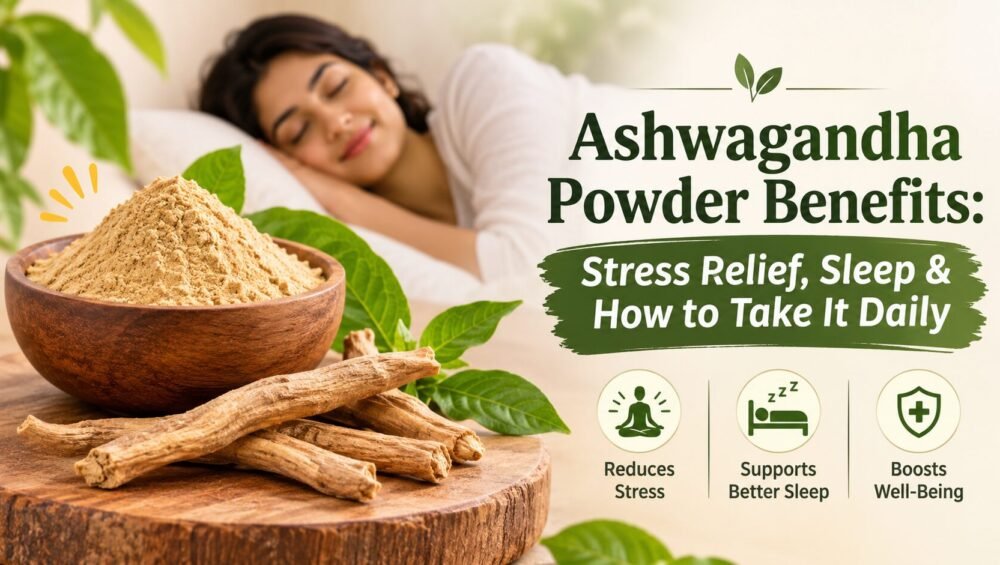
If you have been searching for ashwagandha powder benefits, chances are you want a straight answer to three questions: what does it actually do, how much should I take, and is it safe for me? This guide answers all three in plain language, without hype.
Ashwagandha is one of the most widely used herbs in Ayurveda, and the powder form is the simplest way to take it. It is just the dried, finely ground root, which you can stir into warm milk, a smoothie or a cup of tea. Below you will find the main ashwagandha powder benefits, a clear daily routine, safety notes, and a short checklist for buying a good quality organic ashwagandha powder.
Quick Answer: The main ashwagandha powder benefits are lower stress, better sleep quality, steadier energy and support for strength and recovery. Most adults take about 1/4 to 1/2 teaspoon (1 to 3 grams) a day with warm milk or food, and results usually build over 4 to 8 weeks of steady use.
What Is Ashwagandha Powder?
Ashwagandha (Withania somnifera), also called Indian ginseng or winter cherry, is a shrub that grows in dry regions of India. The root is dried and ground into a fine, beige-brown powder with an earthy, slightly bitter taste and a distinct horsey smell. The Sanskrit name is often explained as the smell of a horse, which is also linked to the traditional belief that the herb brings strength and vigour.
Ashwagandha is classed as an adaptogen, a term used for herbs traditionally taken to help the body cope with physical and mental stress. Organic ashwagandha powder is made from roots grown without synthetic pesticides or fertilisers, which matters because you are consuming the whole root, not an extract.
Ashwagandha Powder Benefits
Most modern research on ashwagandha has been done on root extracts at standardised doses, so results from plain powder can vary from person to person. With that in mind, here are the benefits most commonly associated with regular use.
Stress and Everyday Calm
This is the best-known of all ashwagandha powder benefits. Several human studies suggest ashwagandha may help lower perceived stress and reduce cortisol, the hormone linked to the body’s stress response. People often describe feeling less on edge after a few weeks of steady use rather than after a single dose.
Better Sleep Quality
Ashwagandha is traditionally taken at night, and some studies report improvements in how quickly people fall asleep and how rested they feel. It is not a sedative, but by easing stress it may support a calmer wind-down. This is why many people take ashwagandha powder with warm milk before bed.
Steady Energy and Stamina
Instead of a caffeine-style jolt, ashwagandha is associated with a more even sense of energy and reduced fatigue, particularly in people whose tiredness is linked to stress and poor sleep.
Focus and Mental Clarity
Some research points to modest improvements in attention, memory, and reaction time. If stress clouds your thinking, easing it may indirectly help you concentrate better.
Strength and Recovery
Studies in people doing resistance training have linked ashwagandha with gains in muscle strength and faster recovery. It is not a re
placement for protein or training, but it is a popular add-on in the fitness community.
Hormonal Balance for Men and Women
Ashwagandha has been studied for its effect on testosterone in men and on mood and stress-related symptoms in women. Evidence is still developing, so treat this as a supportive benefit and not a treatment.
The Golden Rule: Consistency beats quantity. Ashwagandha powder works gradually, usually over 4 to 8 weeks of daily use. Taking a larger amount will not speed things up and is more likely to upset your stomach. Start small, stay regular, and let your body adjust.
What to Expect: Ashwagandha Powder Week by Week
Most people want to know one thing before they start: when will I actually feel something? There is no fixed answer, since results depend on your stress levels, sleep habits, diet and dose. This is a realistic picture of how a steady routine often unfolds.
Week 1: Getting Started
Expect very little. Your body is adjusting, and you may notice slightly calmer evenings or mild stomach sensitivity if you take it on an empty stomach. This is the week to stay at 1/4 teaspoon and take it with food or warm milk.
Weeks 2 to 3: Small Shifts
Some people notice subtle changes, such as falling asleep a little more easily or feeling less wound up by daily stress. These changes are usually quiet, so keeping a short note on your sleep and mood each night helps you spot them.
Weeks 4 to 8: The Steady Stretch
This is where most people report the clearest difference, which matches the 4 to 8 week window used in many studies. Stress feels easier to manage, energy feels more even through the day, and sleep tends to feel more restful. If you notice nothing by week 8, review your dose, timing, and the quality of your powder, and speak to your doctor if you are unsure.
After 8 to 12 Weeks: Time to Pause
Many people take a short break at this point and then decide whether to continue. A break also helps you judge what the powder was actually doing for you.
How to Take Ashwagandha Powder Daily
The good news is that taking ashwagandha powder is simple. Here is a practical routine you can follow.
Suggested Amount. A commonly used range is about 1/4 to 1/2 teaspoon (roughly 1 to 3 grams) once or twice a day. If you are new to it, begin with 1/4 teaspoon once a day for the first week and increase only if you feel comfortable.
Best Time to Take It. For stress and daytime calm, take it in the morning or with lunch. For sleep support, take it 30 to 60 minutes before bed. Taking it with food usually helps avoid stomach discomfort.
How Long to Take It. Many people use it in cycles of 8 to 12 weeks, followed by a short break. If you plan to use it for longer, check with your doctor.
Easy Ways to Take Ashwagandha Powder
- Warm Milk at Night: Stir 1/4 to 1/2 teaspoon into a cup of warm milk or a plant-based alternative. Add a little honey or jaggery and a pinch of cardamom to soften the earthy taste.
- Smoothie: Blend into a banana or date smoothie. The sweetness balances the bitterness well.
- Honey Water or Ghee: Mix with a teaspoon of honey or ghee and swallow, the traditional Ayurvedic way. Add honey only once the mixture is not hot.
- Herbal Tea: Add to a cup of warm tea made with ginger or tulsi. A pinch is enough since the flavour is strong.
- Oatmeal or Porridge: Stir into a bowl of warm oats along with fruit and nuts.
A small tip: mix the powder into something warm, not boiling, and stir well so it does not settle at the bottom.
Common Mistakes to Avoid When Taking Ashwagandha Powder
Most disappointing results come from a handful of small mistakes, all easy to fix.
Taking Too Much, Too Soon. Jumping straight to a full teaspoon rarely helps and often causes stomach upset. Start with 1/4 teaspoon and build up slowly.
Expecting Overnight Results. Ashwagandha is not a quick fix. Giving up after three or four days means you stop before it has had a fair chance.
Skipping Days. Irregular use makes it hard to notice any effect. Tie it to a habit, such as your evening glass of milk, so you do not forget.
Stirring It Into Boiling Liquids. Very hot liquid makes the powder clump and the taste harsher. Let your drink cool to warm first.
Buying on Price Alone. The cheapest powder may be old stock or mixed with fillers. Check the label for root-only, organic powder.
Ignoring Medical Advice. If you have a health condition or take regular medication, check with your doctor before you begin.
Who Should Avoid Ashwagandha Powder?
Ashwagandha is generally well tolerated by healthy adults when taken in modest amounts, but it is not right for everyone. Mild side effects can include an upset stomach, loose motions, or drowsiness.
Please speak to your doctor before using it if you are pregnant or breastfeeding, have a thyroid condition, have an autoimmune condition, or take medicines for diabetes, blood pressure, or sleep and anxiety. It is also sensible to stop use a couple of weeks before any planned surgery. Ashwagandha is not meant for children unless advised by a doctor.
This article is for general information and is not a substitute for medical advice.
Ashwagandha Powder for Sleep
Ashwagandha powder for sleep works gently and is not a sedative, so it won’t knock you out like a sleeping pill. It is traditionally taken to help the body settle after a stressful day, and some studies suggest regular use may help people fall asleep faster and feel more rested. To try it, stir 1/4 to 1/2 teaspoon into a cup of warm milk and drink it 30 to 60 minutes before bed. Keep the timing the same each night, because the effect builds over several weeks. If you are pregnant, take sleep or anxiety medication, or have a medical condition, check with your doctor first.
How to Choose a Good Organic Ashwagandha Powder
Since the powder is simply ground root, quality matters. Look for these signs when buying.
- Organic Certification. Choose organic ashwagandha powder so you don’t consume pesticide residue along with the root.
- Root-Only Powder. The label should say ashwagandha root powder, with no fillers, additives, or anti-caking agents.
- Colour and Smell. Good powder is light beige to pale brown with a characteristic earthy smell. A very dark, dusty, or odourless powder may be old or poorly stored.
- Fine, Fresh Texture. A fine texture mixes better into milk and smoothies and sits less in the glass.
- Sealed, Airtight Packaging. Light and moisture reduce the potency of herbs, so look for a well-sealed pouch and store it in a cool, dry place after opening.
Our Organic Ashwagandha Powder is made from carefully ground ashwagandha root, packed to keep it fresh from our Mumbai kitchen to yours.
Frequently Asked Questions
Q1. What are the main ashwagandha powder benefits?
The most commonly reported ashwagandha powder benefits are reduced stress, better sleep quality, steadier energy, improved focus, and support for strength and recovery. Results build over several weeks of regular use.
Q2. How much ashwagandha powder should I take daily?
Most adults use about 1/4 to 1/2 teaspoon (1 to 3 grams) once or twice a day. Start with the lower amount and increase gradually.
Q3. Is it better to take ashwagandha powder in the morning or at night?
Both work. Morning suits stress and energy support, while night suits sleep support. Choose the time you can follow consistently.
Q4. How long does ashwagandha powder take to work?
Some people notice a difference in two weeks, but most see the full effect after 4 to 8 weeks of daily use.
Q5. Can I take ashwagandha powder on an empty stomach?
It is usually better with food or milk, as an empty stomach can cause mild discomfort in some people.
Q6. Is ashwagandha powder or capsule better?
Capsules are convenient and give a measured dose, while powder is more flexible, easier to adjust, and usually more economical. The better option is the one you will take regularly.
Final Thoughts
The ashwagandha powder benefits that people value most are calmer days, better sleep, and steadier energy, built up slowly through daily use. Start with a small amount, pair it with warm milk or a smoothie, stay consistent for a couple of months, and check with your doctor if you have a health condition or take regular medication.
Ready to try it? → Shop Organic Ashwagandha Powder at Nature’s Spice
You May Also Like:
Jaggery Powder: The Healthier Sugar Swap (With Easy and Navratri Recipes)